
Vertical & Layered Growing: How to Boost Output Within Limited Greenhouse Space
For commercial greenhouse growers, agricultural EPC contractors, and farm investment developers worldwide, two core challenges always restrict profitability: limited ground planting area and mismatched cultivation systems for target crops. Many greenhouses—whether newly built or renovated—fail to release full production potential, not due to inferior greenhouse structures or environmental control equipment, but because the planting layer layout and cultivation carrier systems do not fit crop growth rules. This article professionally analyzes how vertical and layered growing systems maximize unit-space output, optimize crop planting logic, and help global agricultural projects avoid mismatched investment and long-term profit losses.
Why Traditional Single-Layer Greenhouse Planting Hits Profit Bottlenecks
Most conventional greenhouses adopt single-plane horizontal planting layouts, which leave massive overhead space idle and cause serious resource waste. For high-value cash crops including tomatoes, cucumbers, peppers, strawberries, blueberries, cut flowers, and hydroponic seedlings, single-layer planting has obvious limitations in commercial operation:
First, land and greenhouse fixed costs cannot be fully amortized. Building and operating a greenhouse requires continuous investment in site leasing, structural maintenance, environmental control, and irrigation power consumption. When only the ground layer is used, the average planting cost per crop unit remains high, compressing profit margins significantly.
Second, seasonal production gaps restrict annual output. Traditional planting is highly dependent on natural light and ground temperature, leading to fixed growth cycles and idle greenhouse periods every year. For investment-oriented greenhouse projects, low space utilization directly results in low asset turnover and extended payback cycles.
Third, uniform single-layer layouts cannot meet differentiated crop needs. Vine vegetables, berry fruits, cut flowers, and seedlings have distinct requirements for planting height, row spacing, light receiving area, and root environment. Blindly adopting universal ground planting layouts will lead to uneven crop growth, increased disease risks, and unstable yield and quality.
Many global clients face common confusion: they clearly invest in high-standard greenhouses and supporting equipment, yet fail to obtain expected returns. The core reason is the separation of greenhouse structure and planting system design. The greenhouse shell determines the growing space, while the vertical layered cultivation system truly determines the effective planting area and final economic benefit.
Core Value of Vertical & Layered Growing: Optimize Space, Match Crops, Stabilize Returns
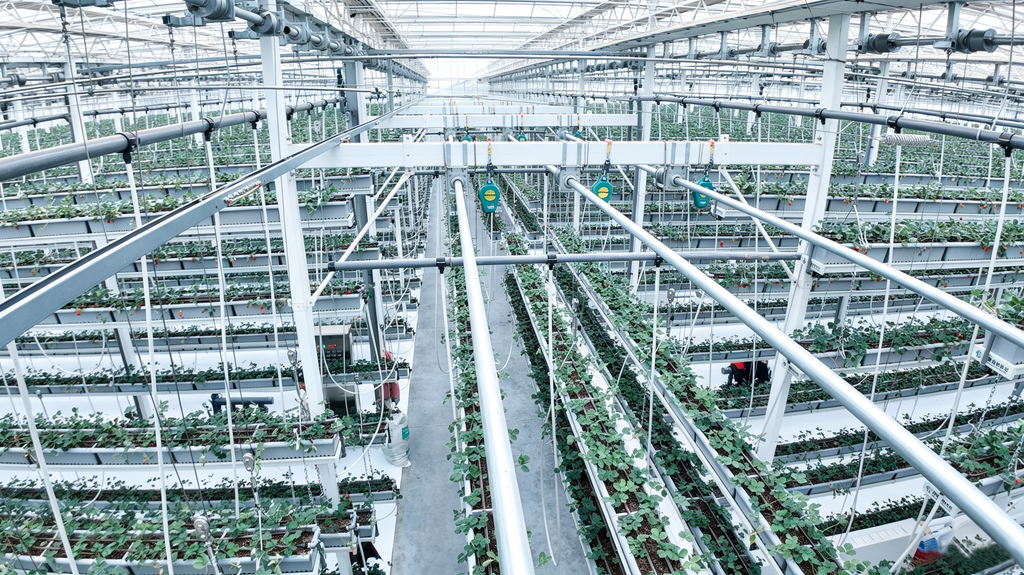
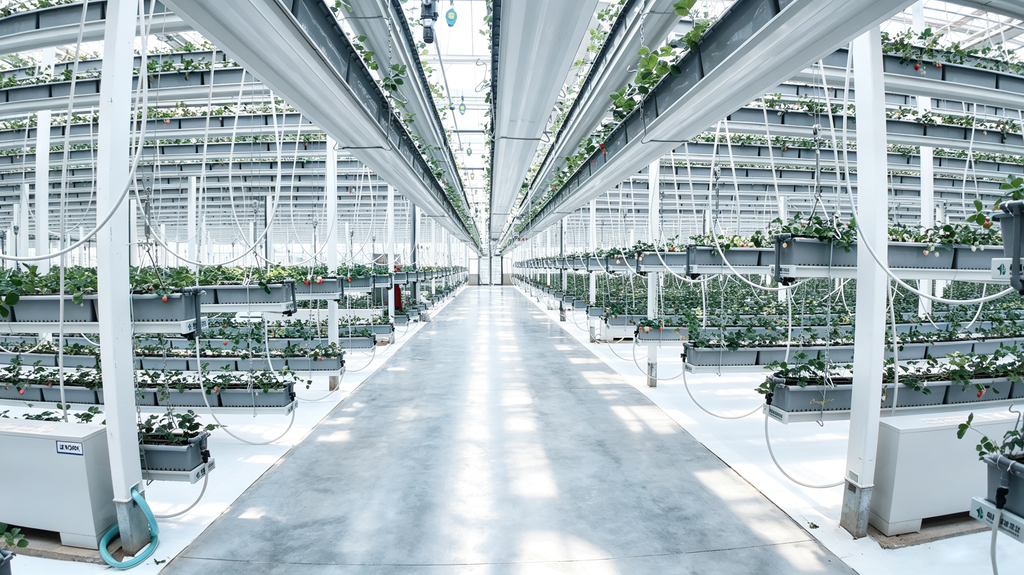
Vertical and layered growing is not a simple stacking of planting equipment, but a crop-oriented standardized space reconstruction solution. It reconstructs the three-dimensional planting space inside the greenhouse through customized cultivation troughs, stable support systems, mobile track structures, and professional metal frame components, realizing layered, categorized, and intensive planting of different crops. Its core value is to solve clients’ key pain points such as blind selection, space waste, and unstable income.
1. Maximize Effective Planting Area and Amplify Annual Output
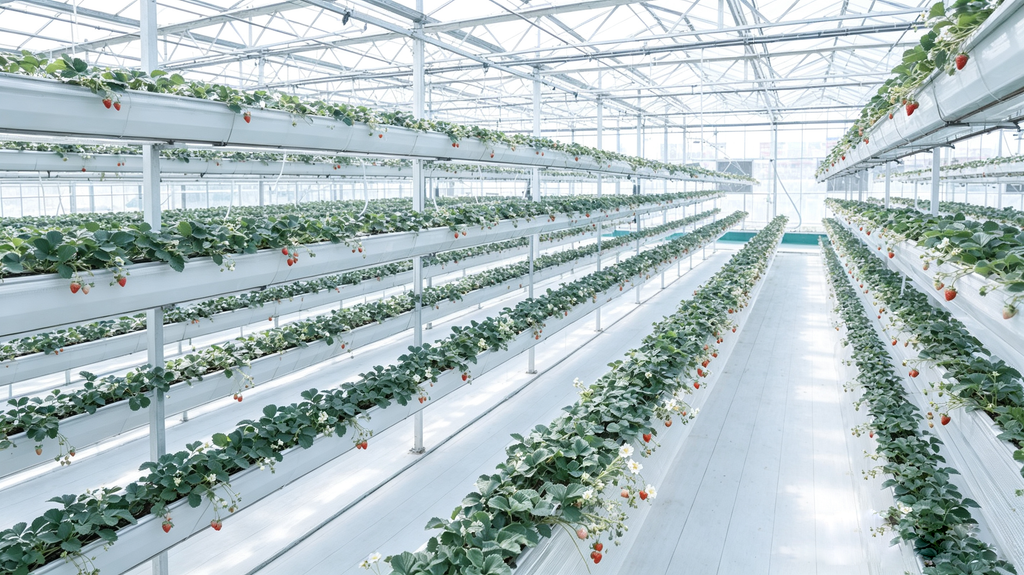
By utilizing the vertical idle space of the greenhouse, layered planting breaks the area limit of the ground plane. For seedling raising, strawberry and blueberry planting, and cut flower production, multi-layer layouts can effectively multiply the effective planting area of a single greenhouse. Matched with scientific light transmission spacing and layered ventilation design, it avoids shading and growth competition between upper and lower layers, ensuring balanced growth of crops on each layer and stable improvement of unit-space comprehensive output.
For vine crops such as tomatoes, cucumbers, and peppers, professional vertical support and traction systems are adopted to change sprawling ground growth into three-dimensional vertical growth. This optimizes the canopy ventilation and light transmission environment, reduces leaf shading and humid microenvironments, lowers the incidence of fungal and bacterial diseases, and improves single-plant fruit setting rate and commodity fruit rate on the premise of unchanged ground area.
2. Customized System Matching for Different Crops to Avoid Investment Mistakes
The biggest risk of greenhouse investment lies in mismatched crop and cultivation systems. Different categories of commercial crops have completely different demands for trough depth, root spacing, load-bearing support, track mobility, and hydroponic irrigation configurations:
– Vine vegetables (tomato, cucumber, pepper): Focus on high-strength vertical support frames and adjustable traction structures, matching the growth rhythm of continuous fruiting and long-term picking, to avoid frame deformation and lodging affecting yield;
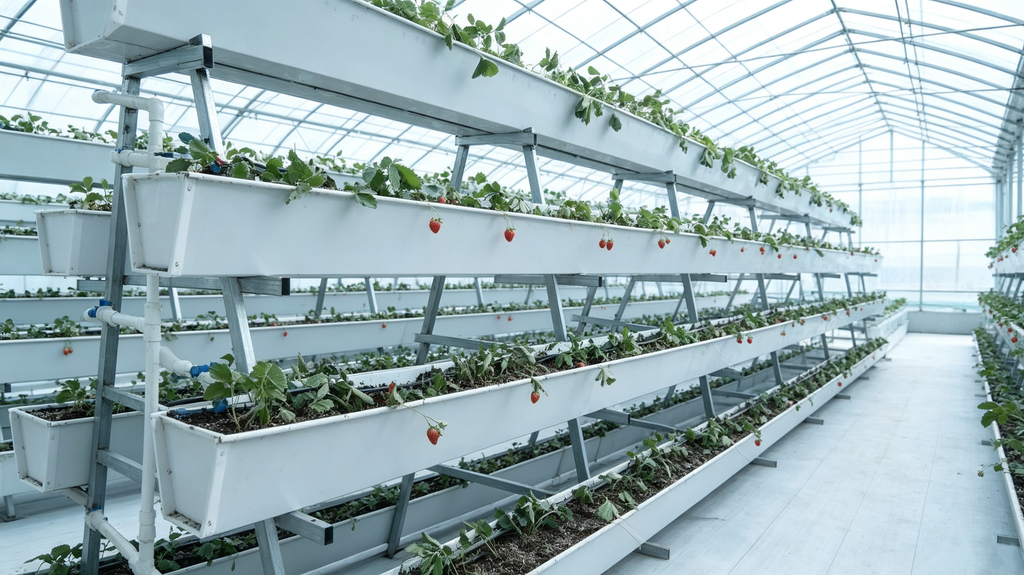
– Berries (strawberry, blueberry): Adapt to shallow trough, dense planting, and mobile layered layouts, convenient for manual picking and daily management, and improve space utilization and picking efficiency;
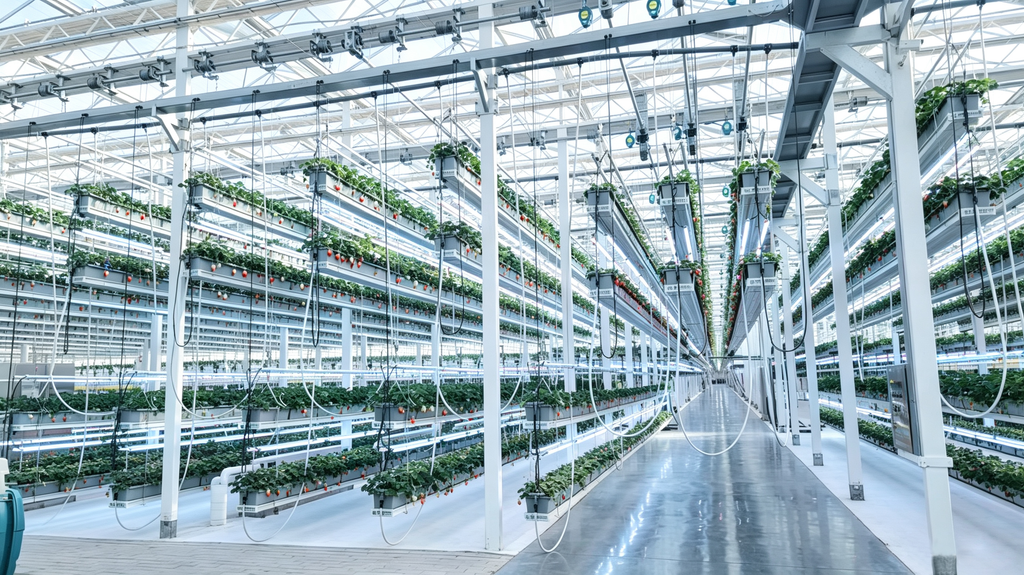
– Cut flowers & hydroponic seedlings: Adopt standardized layered track systems, realizing movable planting beds, convenient batch seedling hardening, flower trimming and harvesting, and improving operational flexibility.
We always adhere to the logic of crop demand first, equipment matching second. Instead of recommending universal equipment to clients, we configure exclusive vertical layered growing systems according to client’s planting varieties, local climate, annual planting cycles, and operation scale, fundamentally eliminating profit losses caused by incorrect selection.
3. Adapt to New Construction & Renovation Projects to Improve Asset Utilization
Many existing greenhouses have complete hull structures and environmental control facilities, but low space utilization and backward planting modes lead to low income. Our vertical layered growing solutions are perfectly applicable to new greenhouse construction and stock greenhouse renovation scenarios.
For newly built projects, we integrate space planning, layer design, and equipment selection in the early stage, realizing one-step standardized layout of cultivation troughs, supports, tracks, and metal components, and reserving matching interfaces for subsequent environmental control and irrigation electrical systems;
For renovated projects, we conduct targeted transformation according to the existing greenhouse span, height, and load-bearing conditions, without large-scale demolition and reconstruction. We quickly activate idle space and upgrade traditional planting modes with low investment and short payback period.
Our Professional Strength: Focus on Planting System, Empower Commercial Profitability
Different from general greenhouse engineering manufacturers who only focus on hull construction, we takecommercial planting benefit improvement as the core, focusing on the R&D, design, and customized supporting of greenhouse core planting systems. Our core products cover all hardware needed for vertical layered planting: standardized and customized cultivation troughs, high-stability planting support frames, mobile walking track systems, and all kinds of greenhouse special metal structural components.
At the same time, we cooperate with high-quality industry partners to support one-stop matching of greenhouse hulls, environmental control systems, and irrigation electrical facilities. We provide global clients with integrated services including scheme customization, professional construction drawings, and whole-process technical support, helping overseas greenhouse farmers, agricultural engineering integrators, EPC general contractors, large planting enterprises, and agricultural investment developers complete standardized and profitable greenhouse project construction and renovation.
Conclusion: Professional Planting System Is the Core of Greenhouse Profitability
The future of commercial greenhouse planting lies not in larger area expansion, but in refined three-dimensional space utilization and crop-adaptive precise planting. A scientific vertical layered growing system can help projects break space constraints, stabilize yield and quality, and reduce operational risks, becoming the core support for long-term profitable operation of greenhouses.
If you are confused about crop planting system selection, or need targeted vertical layered growing schemes and technical solutions for your greenhouse project, welcome to contact us for professional one-to-one project consultation.
Risk Avoidance Explanation (Built-in Compliance Optimization)
This article avoids all absolute advertising words (such as “the best”, “top”, “most advanced”, “zero loss”) and adopts objective industry analysis and scenario-based value expression. All yield and benefit descriptions are based on professional planting logic and project practical scenarios, without false commitment or exaggerated effect guarantee. It conforms to overseas mainstream advertising compliance requirements and industry publicity norms.